Author: James Wilkinson
-
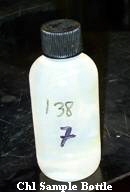
Drawing Chlorophylls
Sample Drawing: 1. Chl samples are drawn on all rosette bottles tripped from ~200m to surface; sampling on a standard 20-bottle cast usually starts at #7 but refer to electronic sample log. For shallow stations, all the bottles may be sampled; noontime prodo casts may have extra bottles to sample; duplicate depths are usually skipped. Refer to…
-
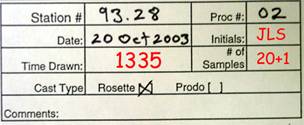
Drawing Nutrients
Retrieve an empty nutrient rack from the lab fridge if needed and record the color key with CESL electronic sample log. Wear latex or vinyl gloves; never touch the inside of the cap or tube since residue from your glove can contaminate the sample. If unavoidable or you drop the lid – rinse several times…
-
Drawing Salts
The sample bottle number should ALWAYS match the rosette bottle number on full casts – check and re-check this during the sample drawing process. If you ever have any doubt about the sample, dump it and start over. Shallow casts with fewer than 20 salt samples may be combined with a previous station. Check with…
-
General Guidelines
Seawater Sampling All sample bottles are rinsed three times before the final fill. The sample bottle number always matches the rosette bottle number on full (20+ bottles closed) stations. On shallow stations, salinity samples may be drawn into an existing case. The watchleader will manage the sample log & bottle numbering in these situations & inform sample…
-
Primary Duties
Tasks normally performed by watchstanders & volunteers after training: CTD prep – draining and rigging of CTD for deployment 20mins before station. Rosette bottles are drained, bottom lanyards unclipped; once drained, all valves are closed and rotated 90°, breathers are closed (lightly finger-tight), & spring-loaded bottles are rigged open so they can be closed at target…
-
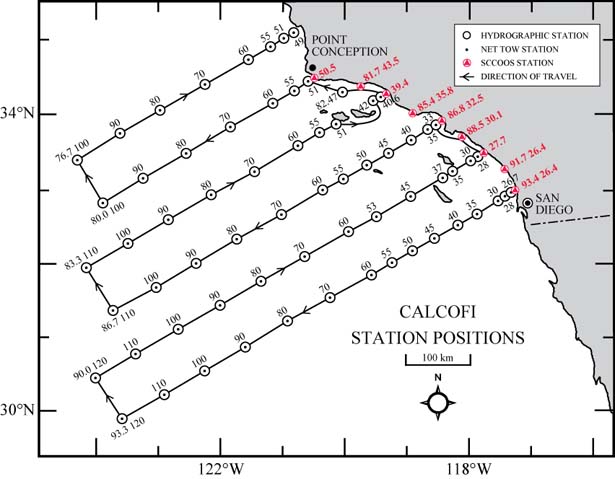
Cruise Overview
The California Cooperative Oceanic Fisheries Investigations (CalCOFI) are a unique partnership of the California Department of Fish and Wildlife, the NOAA Fisheries Service and the Scripps Institution of Oceanography. The organization was formed in 1949 to study the ecological aspects of the collapse of the sardine populations off California. Today its focus has shifted to…
-
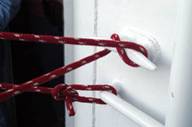
Line Handling
One of the first things taught to new cruise participants is line handling – lines are attached to the CTD-rosette to stabilize it during deployment and recovery. Rough weather & a rolling ship can cause the 800lbs (empty; 363kg) -1500lbs (full; 680kg) CTD-rosette to swing dangerously when the winch lifts it. Taglines allow the CTD-rosette to…
-
RV David Starr Jordan Decommissioned
NOAA Decommissions Long-serving Research Ship 08/05/2010 Courtesy of Marine Technology Reporter (http://former.seadiscovery.com/mt/mtStories.aspx?ShowStrory=1038612086) NOAA recently decommissioned the research vessel NOAA Ship David Starr Jordan during a ceremony in Seattle. The 171-ft. ship conducted oceanographic, marine mammal and fisheries research in the Pacific for more than 40 years. “NOAA Ship David Starr Jordan played an integral and…
-
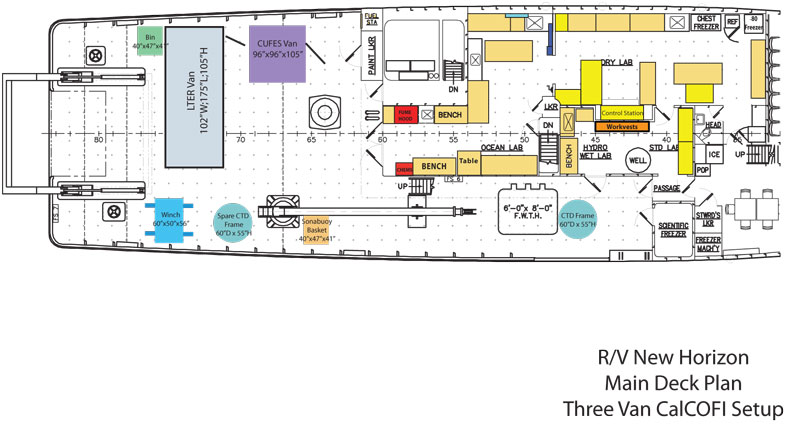
RV New Horizon 3-Van Setup
RV New Horizon CalCOFI Deck & Lab Setup (click on any image for higher resolution) 3 Van Setup: LTER on Main Deck, IOD van on 01; (2 van setup: IOD, LTER, & CUFES vans, IOD van on 01 doesn’t change) J-Frame Net & CTD Block Setup and rigging Marine Mammal Acoustics Winch on starboard…
-
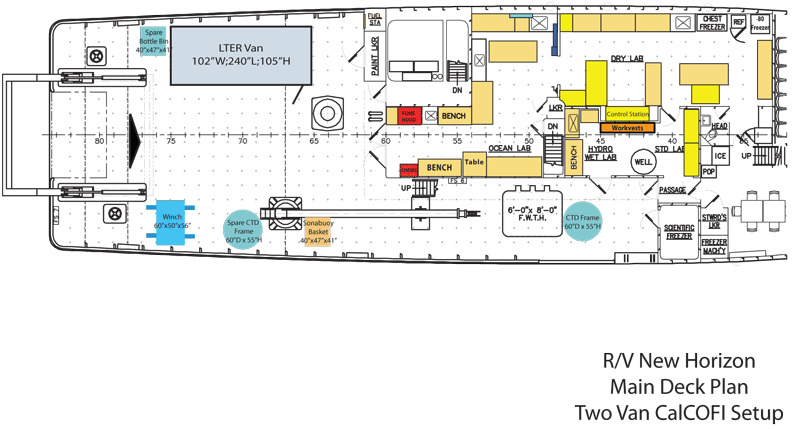
RV New Horizon 2-Van Setup
RV New Horizon CalCOFI Deck & Lab Setup (click on any image for higher resolution) 2 Van Setup: LTER on Main Deck, IOD van on 01; (3 van setup: IOD, LTER, & CUFES vans, IOD van on 01 doesn’t change) J-Frame Net & CTD Block Setup and rigging Marine Mammal Acoustics Winch on starboard…