Author: James Wilkinson
-
SeasaveV7 Setup & Data Acquisition
SeasaveV7 on Windows 7 CTD Operator’s Cookbook Turn on deck unit and be sure what is displayed on the front LED panel are non-zeros. In Seasave v7, select RealTimeData/Start from the menu. Do Not store data on disk immediately so select “Begin archiving data when the start archiving command is sent”. Click [Select Output Data…
-
Particulate Organic Carbon & Nitrogen
CCE LTER measures particulate organic carbon (POC) and nitrogen (PON) by high-temperature combustion. Samples analyzed within the California Current Ecosystem constrain the mean C:N ratio of small particulates and by difference relative to measured living biomass, the biomass of suspended detritus. Complete methods of POC and PON determination can be found here.
-
Dissolved Inorganic Carbon
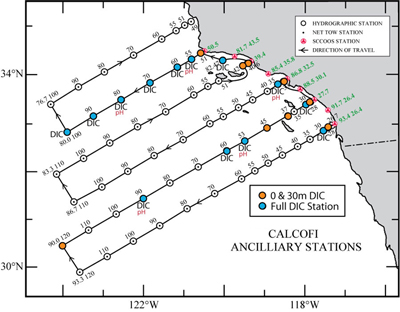
DIC: Dissolved Inorganic Carbon The CalCOFI group collects samples for the characterization of the inorganic carbon system at selected locations along the cruise track. Total inorganic carbon and alkalinity are measured which allows the calculation of pH and pCO2. The objectives of these measurements are: first, the long-term characterization of the inorganic carbon system and…
-
CTD System
A Sea-Bird Electronics 911plus V2 CTD collects vertical profile data at every CalCOFI station. In addition to being a dual TCO (temperature, conductivity, and oxygen) system, the CTD also interfaces with a transmissometer, fluorometer, PAR/SPAR meters, altimeter, nitrate, and pH sensor. Connected to a shipboard data-acquisition computer through an electronically-conductive winch wire, sensor data are…
-
ISUS Nitrate
ISUS Nitrate Sensor SUMMARY: Since November 2004, a Satlantic ISUS nitrate sensor has been integrated with a Seabird 911+ CTD-Rosette system deployed on CalCOFI cruises. Cruises typically occupy 75 stations, collecting approximately 1400 discrete seawater samples throughout the water column. The discrete seawater samples are analyzed at-sea for nitrate, nitrite, silicate, phosphate and ammonia…
-
Chlorophyll-a
Chlorophyll-a & Phaeopigments Chlorophyll a is cold-extracted in a 90% acetone solution for ~24 hours. Chlorophyll and phaeopigments are then measured fluorometrically using an acidification technique. The method used today is based on those developed by Yentsch and Menzel (1963), Holm-Hansen et al. (1965) and Lorenzen (1967). Note that concentrations of ‘phaeopigments’ are not a…
-
Salinity Sampling
Salinity On each station, seawater salinity samples of ~225 mL are drawn from all CTD-rosette bottles closed during the cast. A Guildline Instruments Portasal™ Salinometer (8410A) measures the seawater sample conductivity precisely, comparing it to a reference seawater standard. From these comparisons, salinities are calculated and logged using Windows-PC based software that averages data that…
-
Sta.csv Index: 2014 Data Format
A station csv (sta.csv) is generated for each hydrographic station occupied during a cruise. Bottle data records for each depth are built & populated during sample analysis and data processing.
-
Primary Productivity History
PRIMARY PRODUCTIVITY CHANGES A description of the method was written February 2010 by D. Wolgast. Changes to the method are listed below. Radioactive Specific Activity Changes Section Date Prepared By Description 3.3 6/10/2016 D. Wolgast 25mCi diluted to 32uCi/ml Batch 0509YW4, 800mls 3.3 8/8/2014 D. Wolgast New 14C Stock: diluted to…
-
Primary Productivity Methods
PRIMARY PRODUCTIVITY OVERVIEW: Primary production is estimated from 14C uptake using a simulated in situ technique in which the assimilation of dissolved inorganic carbon by phytoplankton yields a measure of the rate of photosynthetic primary production in the euphotic zone. 1. Principle Seawater samples are incubated with a radioactive substrate to determine the…